Every day, technology accompanies us through an ever-growing number of activities. It reminds us of appointments, tracks how much we move, monitors our sleep, organizes our days, and suggests what to do next.
Even when it comes to wellbeing, there is a risk of turning these tools into yet another voice telling us what to do.
A notification reminds us to move. An app suggests when to work out. Another invites us to meditate.
But what if technology adapted to our pace instead?
Listen before you act
Our bodies are constantly sending us signals.
Our breathing patterns change, as do our heart rate, our body’s response to stimuli, and our level of activation. These signals accompany us throughout the day, even when our attention is focused elsewhere.
We often notice them only when they become hard to ignore.
A particularly intense day can leave us feeling drained. An important meeting can change the way we breathe. A moment of pressure can bring tension and make it harder to regain focus.
Learning to recognize these signals means developing a more mindful way of listening to our bodies.
And this is where technology can play a different role.
When technology adapts to the person
For a long time, we have thought of technology as something that helps us do more, faster and more efficiently.
In the field of wellbeing, it can also serve another purpose: helping us make space.
The difference lies in how it is designed.
A truly useful tool should fit into our daily lives without adding another routine we have to follow. It should support us when we choose to pause, respecting the rhythm of our day and what we need in that moment.
A pause during a workday can serve one purpose.
A few minutes before a workout, it can serve another.
In the evening, as the pace slows down, it can instead become a space to reconnect with the present moment and listen inwardly.
There is no single way to take care of ourselves. There are different moments, different people, and different rhythms.
From data to awareness
Technology can collect vast amounts of information. Its true value emerges when that data becomes meaningful and helps us better understand our own experience.
It is the principle behind biofeedback: making certain physiological responses visible to foster greater awareness of what is happening in the body.
In this way, data stops being just a number.
It can become an invitation to pause, observe, breathe, and understand what is happening.
Technology thus becomes a bridge between what happens in the body and what we are able to perceive.
The right moment is the one you choose
Imagine three moments from the same day.
- In the morning, before the day’s commitments begin, there may be a desire to create a moment of presence.
- During the workday, there may be a need to pause for a few minutes, step away from an intense pace, and regain clarity.
- In the evening, it can instead be helpful to ease the transition from the day into rest.
The tool can be the same. The moment, the purpose, and the experience can change.
This personalization matters because wellbeing does not follow a one-size-fits-all formula. Even pauses need to find their own place in real life.
Ianumind QUI: technology that follows your rhythm
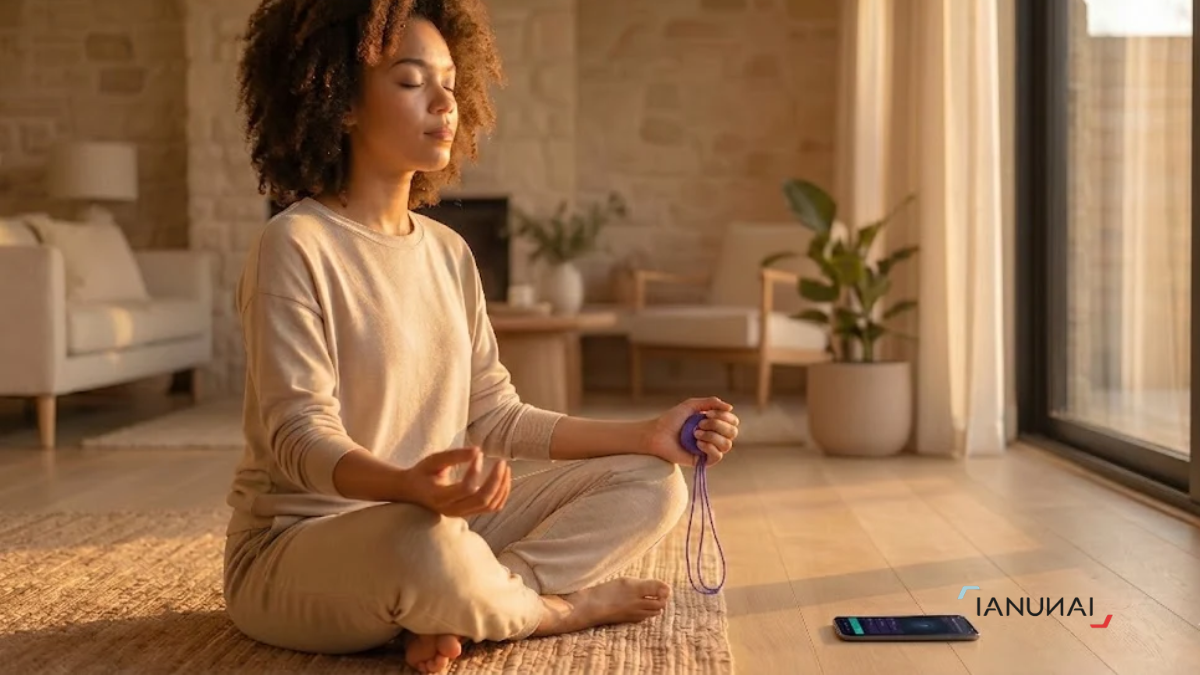
This is the idea behind Ianumind QUI, the compact device developed by Ianunai to help people better understand their body’s physiological signals and turn them into useful insights for everyday life.
QUI can support different moments throughout the day, leaving it up to each person to decide when to use it. The Ianumind app combines intuitive visualizations, guided breathing, meditation and grounding sessions, and an AI coach designed to support the journey toward greater self-awareness and body awareness.
The goal is to create a different relationship with technology: a tool that helps us recognize what is happening within us and choose how to respond, rather than adding another demand on our attention.
Perhaps the future of wellbeing technology is not about constantly adding new features, but about understanding when it is truly helpful to step in.
Because taking care of ourselves means following our own rhythm.
And when technology is designed around this freedom, it can become a tool for reclaiming time, attention, and presence in everyday life.